

How Often Should the Content Be Added to the Website?
Adding or republishing content on the web is an important part of content marketing and overall search engine optimization. Therefore, the question often arises, how often and in what amounts should content be added to the web?
Why to publish and update content on the website?
The site is up-to-date and relevant to the user
Regularly adding new content or updating old content signals to search engines that the page is still active and therefore relevant. As Google strives to offer its users the best results, websites with up-to-date and relevant content are also perceived by search engines as more reliable and therefore gain more authority.
This point is particularly important for content presentation sites such as blogs. E-commerce sites usually indicate activity to search engines by adding or updating products.
In the case of websites with news and articles, Google specifically takes into account the actuality of the content with its freshness algorithm. The algorithm has the task of identifying search phrases where the consumer is interested in up-to-date content. The freshness algorithm then moves articles with up-to-date content to higher positions in the SERP (search engine result page).
Better visibility and organic traffic
By having more unique, high-quality, and relevant content on your website, you can ensure better coverage of keywords relevant to your site. With better coverage of relevant words, there is also a higher likelihood of ranking for more keywords in the SERP. This way, you can organically ensure higher page traffic and brand visibility.
Getting backlinks
Quality and up-to-date content can ensure the page has a higher likelihood of gaining backlinks. Other sites can link to your page and, thanks to backlinks, link juice will subsequently be transferred to your page. This will give your page more authority in the eyes of search engines.
In what quantities is it appropriate to publish content on the web?
Matt Cutts, who co-invented the web spam patent for Google, opined in 2013 that posting large amounts of content in a short amount of time can alert Google to spam. For this reason, individual pages will have to be crawled by Google. Similarly, Matt Cutts, in his video, recommended adding content to the web in smaller amounts to help sites avoid such suspicion.
This claim was refuted in 2017 by John Mueller, the chief trends analyst for webmasters and head of search relations at Google. John Mueller explained that adding a large amount of content to a page at once will not cause problems from an SEO perspective. The only problem may be the load on the server, which will need to be able to cope with crawling such a large amount of content.
Most recently, John Mueller commented on this topic on 3/18/2024 on the X platform (Twitter). The head of search relations at Google was asked whether the mass publishing of 40 to 50 articles on the web could be perceived by Google as spam. In John Mueller’s words, content is not perceived as spam simply because of the way it is posted. If a site publishes a small amount of content with low quality, the content will be ranked poorly by Google. The mass publication of a large amount of high-quality and relevant content, on the other hand, is positive from Google’s point of view.
Finally, John Mueller noted that how content is published has no bearing on how Google will rank it.
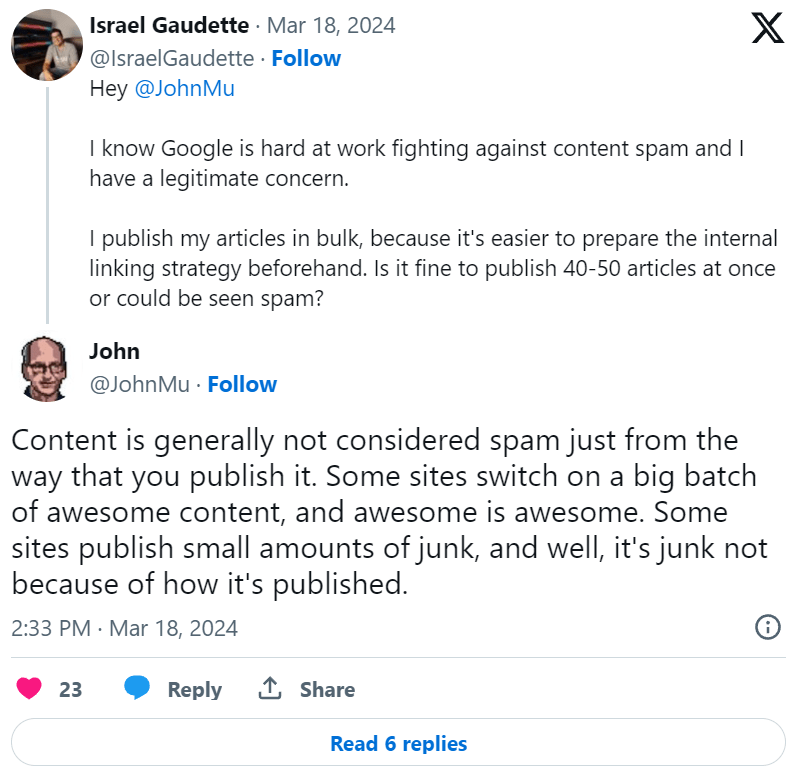
Source: Twitter John Mueller
How often is it appropriate to publish content on the website?
The recommended frequency of adding content to the web has never been defined by Google. It is generally recommended to add new content 3 to 4 times a week. However, this time interval is closely related to the type of site itself. If you run a website with the news, you should add content as often as possible to be able to react quickly to changes. If you run a site with evergreen content, you don’t have to play duel with time, but publishing or republishing content regularly is important.
As John Mueller mentioned in his tweet on Platform X, content quality is key for Google. In this case, you don’t even have to worry about publishing more content at once.
Sources
- https://growhackscale.com/seo/google-freshness-algorithm
- https://www.linkedin.com/pulse/what-impact-content-freshness-regular
- https://en.wikipedia.org/wiki/Matt_Cutts
- https://www.seroundtable.com/google-mass-publishing-seo-24110.html
- https://www.seroundtable.com/google-too-many-pages-16664.html
- https://www.seroundtable.com/google-publishing-content-in-bulk-spam-37077.html