

AI Search Is Here: What Websites Need to Prepare For
AI in search is no longer an experiment – it’s already transforming how people look for information and, more importantly, how Google responds. For brands and marketers alike, the old certainties that governed search visibility are rapidly fading.
This article offers a strategic overview of these ongoing changes. We’ll explain what the rise of AI search means for your business and how to adapt to it. Instead of chasing short-term tactics that change every month, we’ll focus on the deeper strategic mindset shifts that will define which brands succeed in the age of AI.
Why the Drop in Traffic Is No Surprise
Today’s decline in organic traffic isn’t an anomaly – it’s the logical outcome of Google’s long-term evolution. Over the years, Google has steadily redirected user attention away from publishers’ websites and toward its own ecosystem. The goal has always been the same: to satisfy searchers as quickly as possible while keeping them inside Google’s environment.
The drop in click-through rate (CTR) is simply a natural consequence of this shift.
First came paid ads, seamlessly integrated into the results page. Then Google added richer formats – Maps, Images, Videos, Shopping – and later, direct answers and featured snippets that deliver information instantly, without a single click.
With the arrival of generative AI, this trend hit full force in 2025 across Slovakia and the Czech Republic. Google introduced AI Overviews, which summarise answers directly within search results, followed by AI Mode, allowing users to hold a conversation with Search itself and move fluidly between content types.
In short: traffic loss isn’t a glitch — it’s a new default.

How Generative AI Redefined the Search Landscape
While Google had been steadily refining its traditional search model, the rise of generative AI created space for new players — and completely reshaped user expectations.
According to the latest data, ChatGPT quickly established dominance in the AI search segment, capturing nearly 80% of market share. Google was initially slow to react, leaving room for emerging competitors such as DeepSeek, Grok, Perplexity, Claude, and Copilot to claim their space in the new search ecosystem.
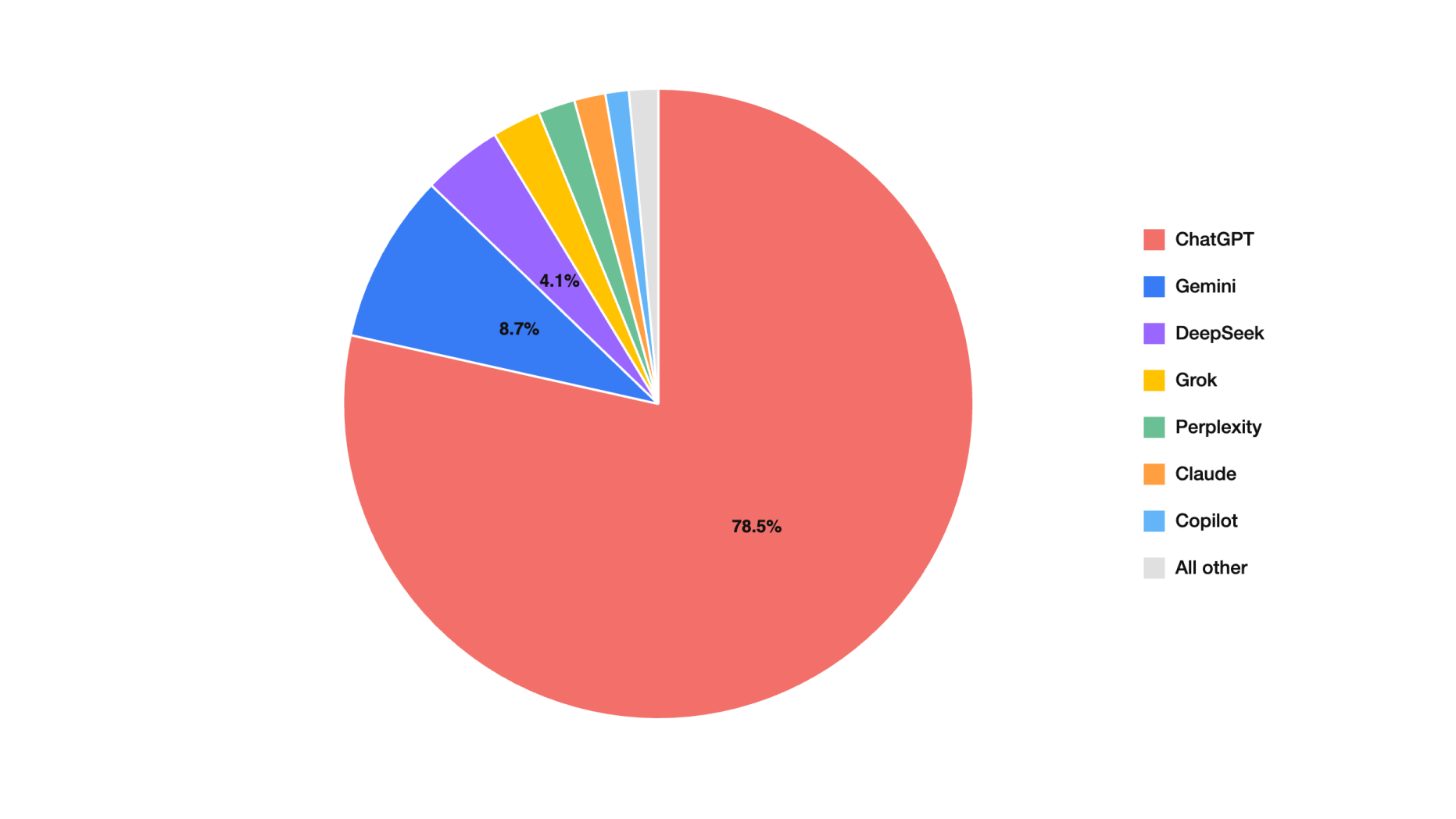
At first glance, it might seem like Google is losing the race. But the reality is more nuanced.
Look Beyond the Hype
ChatGPT’s dominance needs to be viewed in context. Current data shows that 95% of ChatGPT’s audience overlaps with Google’s. In other words, people aren’t replacing Google with ChatGPT – they’re using both, often for different purposes.
For now, ChatGPT is used primarily for content generation and ideation, while Google remains the go-to platform for information discovery and verification.

This overlap explains Google’s strategic move with AI Mode: to convert mainstream users – those who haven’t yet adopted AI tools – into its own AI-powered search experience, regaining market share and keeping users within the Google ecosystem.
It’s not just a competitive response; it’s a natural evolution aligned with changing consumer behaviour.
Will Consumers Embrace AI Search?
The success of any technology ultimately depends on mass adoption. AI-powered search is poised to succeed because it solves real problems that users have long struggled with in traditional search.
According to recent studies by the World Economic Forum, Euromonitor, and Capgemini, the main drivers of AI search adoption are clear:
- Most consumers feel overwhelmed by excessive choice and the constant flood of ads.
- They actively seek clarity, efficiency, and personalized recommendations.
- Nearly 68% believe that generative AI will simplify their experience by combining results from multiple sources into one clear, easy-to-navigate “one-stop shop”.
AI Isn’t Just Changing Search – It’s Changing Decisions
This shift shows up in three fundamental ways:
- Intent and style – Users are moving away from short keyword queries (e.g., “beach holidays nearby”) toward natural-language requests that express full needs (e.g., “show me seaside destinations within driving distance from Slovakia”).
- Journey – The once-fragmented discovery process is collapsing into three simple steps – need → solution → action. Users no longer browse dozens of pages; AI serves the answer directly.
- Action – A website’s role is evolving. It’s no longer just the place where conversions happen but a data source for AI systems. The actual transaction – a purchase, booking, or sign-up – will increasingly occur inside the AI interface itself, through integrated agentic functions.
This fundamental change in user behaviour creates entirely new demands for brands and their digital strategies.
Visibility in AI: The New Metric of Success
In a world where clicks are losing their meaning, traditional SEO metrics like rankings and CTR are no longer reliable indicators of success.
The new performance benchmark is AI visibility – how often and how prominently your brand appears within AI-generated answers and conversations. Success won’t depend on where your website ranks, but on whether AI systems recognize, trust, and recommend your brand as a credible solution.
How AI visibility differs from traditional SEO:
- Rankings matter less – Studies show that over a third of brands occupying top positions in organic search never appear in AI-generated responses at all.
- Same foundation, different weighting – Technical, content, and authority factors remain essential, but their influence shifts in the AI context.
- Broader digital footprint – AI models draw not only from your website but also from your mentions, citations, and overall brand presence across the web. In short, they learn from your entire online ecosystem, not just your site.
- Personalization at scale – AI search results vary based on user profiles, context, and intent. Two identical queries from the same person can produce different answers – because AI continually refines results based on prior interactions and inferred preferences.
AI visibility therefore depends less on technical optimization alone and more on trust, authority, and brand reputation in the wider digital environment.
Where to Start as Search Evolves
1. Assess Your Dependence on Organic Search
Before taking any major steps, begin with a risk assessment. Evaluate how much your business model relies on organic traffic. Heavy dependence on a single channel — especially one facing major disruption — is a strategic risk.
For example, a content publisher whose revenue comes almost entirely from pageviews is far more vulnerable than an e-commerce brand that drives sales through multiple channels. A clear audit should show how resilient your business would be if the rules of online visibility suddenly changed.
As part of this assessment, look closely at your brand strength:
- How often do people search for your brand directly?
- How do they perceive it?
- Do AI systems recognize and understand it?
A strong brand acts as natural protection against declining visibility, offering a crucial advantage in the AI-driven search era.
2. From Clicks to AI Visibility
Achieving real visibility in the age of AI requires a fundamental change in mindset. Traditional SEO is no longer about ranking higher or chasing more clicks – it’s about helping AI systems recognize, trust, and recommend your brand.
In this new environment, SEO success isn’t measured by traffic volume but by authority and recognition. Brands that become trusted reference points for AI will hold a lasting advantage, because their content shapes the user’s decision process directly.
Simply put: the future of SEO is about being found by AI, not just by humans.
3. Strengthen Your Technical Foundation
AI can only process what it can clearly read and understand. A site with messy structure, inaccessible elements, or hidden content is effectively invisible to AI systems. Your website must therefore be technically sound and semantically structured.
That means:
- Clean, crawlable architecture
- Well-defined hierarchy and metadata
- Proper use of structured data markup
AI requires clear, consistent, and machine-readable data. Technical readiness isn’t optional – it’s the baseline for visibility in the new search environment.
4. Build Expertise Through Deep, Connected Content
In the age of AI, a single well-optimized article is no longer enough. AI models look for depth, accuracy, and semantic connections that demonstrate real expertise. The more comprehensively your site covers related topics – and the better those pieces are interlinked – the stronger your signal of topical authority becomes.
By systematically developing content clusters around key themes, you create a cohesive knowledge ecosystem that AI can easily interpret and trust. What matters isn’t just keyword targeting, but the contextual density and precision of your information.
Comprehensive, interlinked content tells AI and people: this brand knows what it’s talking about.
5. Expand Mentions & Reputation Across the Web
Authority isn’t built solely on your own domain. AI models track how often – and in what context – your brand is mentioned across the internet: in media, reviews, forums, and professional citations.
These independent signals reinforce your perceived credibility.
In essence, brand reputation and natural digital connections now function as a new form of link building. If no one is talking about your brand, AI has no reason to consider it a trusted source.
Focus on earning authentic mentions in relevant, high-authority environments that align with your niche.
6. Measure AI Visibility Pragmatically
Right now, there are no universally accepted metrics to measure how often your content appears in AI-generated responses. Until such tools emerge, brands need to rely on proxy data and observational signals to evaluate their presence in AI search.
A practical approach includes:
- Monitoring brand mentions within AI answers – noting when and how your content is cited or referenced.
- Analyzing bot traffic to your site – these interactions often indicate how AI systems are crawling and processing your data.
- Tracking behavioural shifts in user journeys after AI search features launch – for example, changes in how users discover or engage with your brand.
This pragmatic measurement helps brands navigate an evolving landscape – adapting content for AI visibility even before standardized KPIs exist.
7. Strategically Integrate SEO & Paid Media
Google is already testing ads integrated directly into AI experiences (mostly US) – not only above and below AI-generated results, but also within AI Overviews and AI Mode itself. This shift redefines how brands connect with potential customers.
Ads are no longer triggered solely by keywords. They now respond to context and intent, creating new “moments of relevance” – situations where the user hasn’t yet searched for a specific product, but AI naturally guides them toward it.
For brands, this means SEO and PPC must work hand in hand. The quality and structure of your content – the very material AI relies on – will directly influence how relevant your paid ads appear.
The winners will be the brands that:
- Already use Performance Max, Shopping, and Broad Match effectively
- Treat organic and paid visibility as parts of a single, integrated strategy
Focus on contextual relevance, not just keyword targeting
Final Thought
We’ve reached a turning point. The old world of rankings and clicks is fading, and a new era of AI-driven visibility is beginning.
The key message is simple:
Clinging to clicks in a system that’s moving beyond them is a dead end.
What lies ahead is not a minor adjustment but a complete transformation – one that demands courage to rethink long-standing strategies and adapt to new realities.
Yet, this isn’t something to fear. It’s an opportunity – to build a stronger, more resilient, and genuinely visible brand that thrives in the digital ecosystems of the future.
Your customers are already asking AI about you. The real question is: what does AI say in return?
To stay ahead of the curve, follow our Rank Master 3000 series, where we dive deep into how brands can adapt and succeed in the new era of AI search.
Sources
- www.weforum.org/stories/2025/04/ai-transformation-consumer-industries-wef-report/
- www.capgemini.com/insights/research-library/what-matters-to-todays-consumer-2025/
- go.euromonitor.com/white-paper-2025-global-consumer-trends.html
- www.semrush.com/blog/ai-search-report/
- ahrefs.com/blog/chatgpt-google-citations/
- openai.com/index/how-people-are-using-chatgpt/
- www.chatoptic.com/blog/google-chatgpt-visibility-study
- www.aleydasolis.com/en/ai-search/key-traditional-search-ai-comparison/
- www.linkedin.com/feed/update/urn:li:activity:7371075710423023616/
- x.com/similarweb/status/1955207397946855548?s=46&t=nR2jsBH7Y-mwlV0eY8ggwA
- support.google.com/google-ads/answer/16297775?hl=en
- business.google.com/uk/think/ai-excellence/google-marketing-live-2025/
- blog.google/products/ads-commerce/google-search-ai-brand-discovery/